Social issues

  • Regulations about the depiction of children in art

    depiction of children in art cartoon

    A cartoon about regulations about the depiction of images of children in art.

    The cartoon shows an old oil painting of a child in an art gallery.
    The painting has been restored and modified to comply with regulations concerning the depiction of minors.

    The child’s face has been pixelated to comply with the rules.
    In real life rules on the depiction of children apply to certain media (in which the faces may be blurred), but not to old oil paintings.

    Cartoon drawn: 2019

    Cartoon reference number: art024
    This cartoon features in my book of cartoons about art.
    See the book here.
    How to search for cartoons by subject
  • The etiquette of using a mobile phone in an art gallery

    The etiquette of using a cell phone in an art gallery cartoon

    A cartoon about the etiquette of using a cell phone in an art gallery.

    The cartoon shows a visitor to an art gallery talking on a mobile phone in the gallery.

    The cartoon is about the tensions that can occur in public spaces concerning the inconsiderate use of mobile phones, especially if the user speaks in a load voice and seems oblivious to their surroundings.
    Art galleries are usually quiet spaces (although there are some schools of thought that think that they should be more lively (and therefore more accessible to people who feel intimidated by the reverence normally afforded to art).
    The other visitors to the gallery are looking very disapproving.

    Cartoon drawn: 2019

    Cartoon reference number: art015
    This cartoon features in my book of cartoons about art.
    See the book here.
    How to search for cartoons by subject
  • Erasing the offensive past, followed by erasing the offensive present.

    Erase the attitudes of the past cartoon

    A cartoon about erasing the past because of its flaws, then erasing the present because of its flaws.

    This cartoon is about the current trend (2020) for some groups to want to erase evidence of the parts of the past that they find offensive. This is manifested in the pulling down of statues of people who had links to the slave trade.
    The point of the cartoon is that I think that such attitudes and approaches are misguided, as they require a (selective) moral purity that is impossible in a complex world full of complex people. The wish to erase the moral imperfections of the past would lead to the wish to erase the moral imperfections of the present, and in an imperfect world full of imperfect people the consequences of that could be a form of repression not dissimilar to some of the religious and political repressions of the past. Bear in mind that people are still capable of creating repressive societies in the misguided belief that they are doing a good thing – people don’t change, just their situation.
    The imagery in the cartoon is based on the Bonfire of the Vanities – the burning of objects that the church considered sinful, such as books, art and mirrors which happened in Florence, Italy in 1497. It also relates to book burning by the nazis in Germany and the destruction of degenerate or subversive objects in other states ranging from communist regimes to the Taliban.

    Drawn: 3rd July 2020
    Cartoon reference: a813
    How to search for cartoons by subject
    cartoon copyright matters
  • Edward Colston statue cartoon

    Colston statue cartoon

    A cartoon about the irony that Edward Colston’s money was used to benefit worthwhile institutions in Bristol (and London).

    This cartoon is about the toppling of the statue of Edward Colston by protesters in Bristol because he was involved in the trans-Atlantic slave trade.
    It is about the complex and messy nature of financial and social endeavour, and the complex and messy nature of people.
    It is about the broader issue of how money is generated to finance society in general, especially its more worthy aspects.
    This is not a cartoon defending the statue of Colston (as I’m generally against the concept of statues of prominent people anyway, although I wouldn’t get rid of them either).

    Drawn:8th June 2020
    Cartoon reference number: a804
    How to search for cartoons by subject
  • Judging historical figures by contemporary standards

    statue toppling cartoon

    A cartoon about toppling statues.

    This cartoon is about the judging of historical figures by modern standards of ethics and morality.
    The cartoon was drawn during a campaign of statue toppling in 2020 that started with the toppling of a statue of Edward Colston in Bristol. Colston made money in the slave trade. His statue was erected to celebrate his later philanthropic donations.
    The cartoon attempts to illustrate the problem of judging historical figures by the moral and ethical standards of today by showing the absurd (and hopefully comic) situation of a statue being toppled because the person represented by the statue was not a vegan. Veganism is generally speaking a very modern lifestyle choice that would be unknown to historical figures.
    It is also about the phenomenon of people sometimes committing disproportionately excessive acts if they hold their views with a high degree of righteous zeal.
    It is also about mission creep – the current campaigns about statue toppling began with racism but may extend to other areas.

    Drawn:11th June 2020
    Cartoon reference number: a806
    How to search for cartoons by subject
  • Sugar and slavery cartoon

    Sugar and slavery cartoon

    Sugar and its historic links to slavery.

    The cartoon shows someone boycotting the use of sugar because of its historical links to the slave trade.

    It’s also a cartoon about people who posture and who take extreme positions on issues.
    Drawn: September 2020
    Cartoon reference number: a854
  • Enlightenment entitlement cartoon

    Enlightenment entitlement cartoon

    From the Enlightenment to entitlement – cartoon.

    The cartoon shows a person in the Age of Enlightenment pondering on the fact that the earth revolves round the sun.
    Another person, from the current Age of Entitlement meanwhile thinks that “The world revolves round me”.

    A cartoon about the contemporary age of identity politics, entitlement and solipsism and self-centred world views.
    Drawn: September 2020
    Cartoon reference number: a852
  • Anti-enlightenment cartoon – the Endarkenment

    Anti-enlightenment cartoon – the endarkenment

    From the Enlightenment to the Endarkenment – cartoon.

    When I drew this cartoon I was very pleased when the term “The Endarkenment” came into my head as an original thought. I looked it up later and found that it’s been thought of before, to describe the same phenomenon.
    I use it as a term for the current trend towards anti-rational thought, which includes anti-scientific, anti-historical and anti-establishment thought (I like to think I’m a bit anti-establishment myself, but definitely not anti-scientific or anti-historical).

    The statue that is being toppled in the Endarkenment frame of the cartoon is based on the current phenomenon of the iconoclastic toppling of statues of establishment figures who are possibly linked to the slave trade (Many of them are, but the action is largely motivated by emotion, with little regard for historical context).

    Drawn: September 2020
    Cartoon reference number: a851
  • Critical race theory and science in universities – cartoon

    culture wars cartoon universities race and science

    Culture wars cartoon – race and science in universities.

    Update:

    I drew this cartoon in 2020. At the time I thought that the idea that CRT could be applied to scientific subjects such as mathematics or cosmology was so outlandish that a cartoon that suggested such a thing would be funny due to its sheer absurdity. It’s started to happen.

    ––––––––––––––––––––

    Culture wars are raging in universities and academic institutions across the western world. They are raging elsewhere too, but the culture wars in, say, the Islamic world, are different to the ones in the west.
    The west’s culture wars often circle around subjects such as race and gender and identity politics that exist within the ‘woke’ analysis of culture.

    At the time of drawing this cartoon the subject of race is very much to the fore, with movements such as BLM (Black Lives Matter) having a very high profile.
    In academia many subjects in the social sciences are currently analysed through the perspective of critical race theory (CRT).
    This cartoon illustrates a tendency to apply critical race theory to subjects where it has no relevance or where its relevance is overstated.
    Drawn: September 2020
    Cartoon reference number: a849
  • The outcome of multiple conditions on opportunity – intersectionality illustration

    intersectionality cartoon

    The outcome of multiple life conditions on opportunity and outcome – intersectionality cartoon

    This illustration was drawn for Marxism Today magazine in the mid 1980s.
    It features a machine into which babies enter at the top and adults leave at the bottom.
    The machine represents the workings of society, with tubes and pipes representing functions such as education, class, race, gender etc.
    The adults leaving the machine have all been filtered through the various parts of the machine to produce different types of people. The types of people are produced to suit the conditions and needs of society.
    The illustration could be interpreted as being about what is now called intersectionality (although it was drawn in about 1984 or 1985, before the term intersectionality was coined in 1989 by professor Kimberlé Crenshaw).

    Drawn: mid 1980s
    Cartoon reference number: a845
    intersectionality cartoon
    A detail of the illustration
  • Hate crime cartoon or hate speech cartoon

    Hate speech cartoon - hate crime cartoon

    Hate speech cartoon or hate crime cartoon.

    A comment on the fact that the UK laws around hate crime and hate speech only apply to actions or comments directed at people because they are members of a number of five specific groups. Expressions of hatred on account of a person’s colour, race, nationality, ethnic or national origin, religion, gender identity, sexual orientation or disability are forbidden. Amongst other things the categories don’t include class, which I find intriguing, meaning that calling a working class person riff-raff is okay!

    Drawn: August 2020
    Cartoon reference number: a838
  • ‘Hate Crime’ cartoon – the widening definition of hate crime

    hate crime cartoon

    Hate crime cartoon

    A cartoon about the widening definition of hate crime

    The definition of hate crime seems to be in danger of spreading so that it encompasses some minor or petty slights or insults.

    Cartoon reference number: a767

    How to search for cartoons by subject
  • Women in science

    women in science - cartoon

    A cartoon about women in science and their relationship with the media.

    A cartoon about one of the problems that confront women in the workplace.

    This is an example of my cartoon strip published in Chemistry World, the magazine of the Royal Society of Chemistry, round 2014 – 2015.
    Cartoon reference number: a724

    How to obtain license to use cartoon
  • The “post truth” society

    Cartoon about ignoring the truth in favour of prejudice

    Post truth cartoon or conspiracy theory cartoon.

    Truth and facts being ignored in favour of emotional or prejudiced viewpoints.

    The concept of ignoring the facts when reaching a decision about something, and letting the heart rather than the head rule, seems to be a phenomenon that’s on the rise. It has recently been labelled ‘post truth’.
    In the cartoon I’ve linked it to the phenomenon of conspiracy theories, which are frequently used as a way of justifying irrational or unproven ideas.
    The rise of post truth tendencies is said to be linked to people’s increasing use of social media via phones and electronic media and the tendency for internet algorithms to send people only information that they already agree with – however the tendency has always been there in the way that people purchase newspapers that agree with their political and other views.
    It may also be linked to the current mistrust of experts.
    Cartoon reference number: a756

    How to search for cartoons by subject
  • People immersed in their smart phones unaware of events in the real world

    people engrossed in their smart phones unaware of events in the real world

    A problem of immersive technology – smart phone users oblivious to events round them

    This cartoon is about the way that the use of smart phones encourages people to withdraw from the real world and to become totally immersed in their phones.


    In the cartoon the two young people in the foreground are completely unaware that the city behind them is being destroyed by an alien invasion by flying saucers or ufos (and that this is the reason that their phones have lost their signal). The only thing that they notice is that the signal to their phones has gone.
    The cartoon is an illustration of the potential dangers of immersive technology.
    First published: Prospect magazine, April 2016.
    Cartoon reference number: a729
  • To record or to intervene? The public filming of incidents for social media

    Cartoon - public filming disasters on phones

    A cartoon about the tendency for people to record incidents rather than to intervene in them.

    A cartoon showing people who are dismayed by the fact that there’s a man drowning in front of them, but that they haven’t got their phones with them with which to record the event.

    A cartoon about a dark side to social media and “citizen journalism”.
    Cartoon reference number: a708
  • The adult colouring book craze – the infantilization of popular culture

    Cartoon - the adult colouring book craze

    The adult colouring book craze – the infantilization of popular culture.

    A cartoon showing someone reading an academic book about the fashion for adult colouring books. The academic publication is itself a colouring book.

    A cartoon about the publishing phenomenon of colouring books for adults in the mid 2010s.
    Cartoon drawn: 2015
    Cartoon reference number: a706
  • No Platforming cartoon

    Cartoon - no platforming debates

    “No platforming” – the movement to deny a debating voice to speakers who’s views may be offensive to some of the audience.

    This cartoon is about the phenomenon of denying a platform in debates for speakers who’s views may be found offensive by some of the audience.
    The phenomenon is particularly prevalent in universities.

    “No platforming” can be seen as a form of censorship masquerading as a virtue. It is built on the premise that people have the right not to be offended.
    This may be a worthy aim, but it’s very much open to abuse, as the ‘right not to be offended’ can easily become a means of stifling debate.
    Apart from anything else, the airing of controversial views are crucial to the health of democracy.

    Cartoon drawn: 2015

    Cartoon reference: a705
    How to search for cartoons by subject
    cartoon copyright matters
  • The campaign to remove statues – white male privilege – cartoon

    Remove statues campaign cartoon

    A cartoon inspired by the campaigns to remove statues of slave traders and imperialists from the public sphere (in 2015).

    This cartoon is about the tendency for social grievances around issues such as race and gender to be directed towards people of higher privilege, so in western society almost all grievances are ultimately directed towards white men. Specifically middle-aged or old white men, as young people often have grievances directed towards older people (middle-aged men tend to be commoner targets than older men as they are often in higher positions of power or authority).

    The cartoon was drawn in 2015, five years before the toppling of the statue of Edward Colston in Bristol in 2020. I expect the campaigns and protests to remove statues of other controversial figures such as Cecil Rhodes at Oriel College, Oxford University (Rhodes Must Fall) will now be given new momentum.

    Drawn: 2015
    Cartoon reference number: a805
    How to search for cartoons by subject
  • Cultural infantilisation cartoon

    Infantilisation cartoon

    A cartoon about infantilization in modern society.

    An animal hat worn by an adult.

    A cartoon showing an adult wearing a hat with an animal face on it. These hats were originally designed for small children, however there was a tendency for these animal hats to be adopted by young (and not so young) adults in the 2010s, usually female.
    The person is reading a sociology book that is a critique of the trend towards the infantilisation of culture.
    Cartoon drawn: 2016
    Cartoon reference number: a733
  • Child development cartoon. Nature or nurture?

    child psychology cartoon

    Cartoon about child psychology and child development.

    An image illustrating aggressive tendencies within people. Nature or nurture?
    Cartoon drawn: 2004
    Cartoon reference number: a681
  • Self-driving cars cartoon or driverless cars cartoon

    Self-driving or driverless car cartoon 

    A cartoon about driverless cars.
    How driverless cars may affect society

    Driverless cars are also known as driver-free cars, self driving cars, autonomous cars or robot cars.

    This is a futurology cartoon, predicting the future when self-driving cars are ubiquitous.
    My view is that people will drive round whether they need to or not, simply because they can – a bit like the way people currently spend large amounts of their time glued to mobile phones even though they don’t necessarily have anything pressing to say. You can read an article of mine on the subject of driverless cars here.
    Drawn: 2017
    Cartoon reference number: a674
  • Cartoon – the medicalisation of personality disorders (and of normal personality traits)

    medicalisation of deviant behaviour cartoon

    Medicalisation of deviant behaviour cartoon
    The nature v nurture debate on human personality
    Neurological origins of behavioural traits


    A cartoon about the tendency to invoke medical reasons for deviant personality traits, for abnormal personality traits or even for normal aspects of personality.
    It shows one aspect of the nature v nurture debate

    An illustration about the medicalization of behaviour. This may include behavioural syndromes ranging from psychopathic tendencies and deviance to conditions such as hyperactivity, ADHD (attention deficit-hyperactivity disorder), rebelliousness or non-conformity.
    In this cartoon I’ve invented a medical condition that is being used by a parent to justify her child’s aberrant or antisocial behavior

    The cartoon reflects the tendency to claim, for instance, that particular parts of dna are responsible for criminal behaviour – thus removing responsibility from the person and placing it on the dna
    The image is not meant to imply that there is no neurological basis for behaviour, just that it can sometimes be used as an excuse for bad behaviour
    The subject of neurological origins for criminal behaviour is dealt with in the book The Anatomy of Violence by Adrian Raine

    The cartoon was first published in Prospect magazine in May 2013
    Cartoon reference number: a591
  • Snooper drones cartoon

    private snooper drones

    Personal spy drone cartoon
    The use of drones for private detective work


    This cartoon was drawn when drones were first being developed but were not generally in the public’s awareness. A cartoon about one of the implications of the spread of drone technology in the future if drones become available to the public as personal drones or as civilian surveillance drones in general

    The drone in the image is being used by a husband to spy on his wife
    Advances in drone technology have implications for civil liberties, with the possibility of a Big Brother society
    Click below for another cartoon about the possible use of personal drones Snooper drones
    Cartoon drawn: 2013
    Cartoon reference number: a606
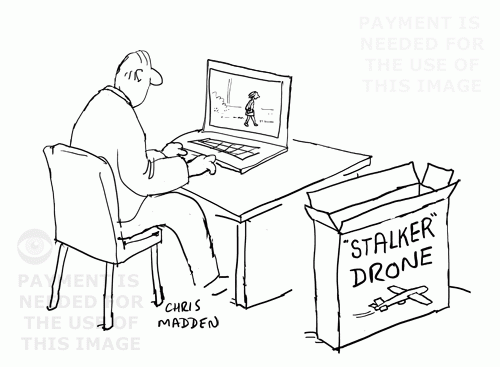
  • Personal snooper drone cartoon – drones used for stalking

    personal drone used for stalking - cartoon

    Personal spy drone cartoon
    An idea about the implications of drone technology
    The use of drones for stalking

    This cartoon was drawn in the early days of drone development, before they were were generally available for use by the public.
    A cartoon about one of the numerous possible misuses of drone technology in the future if drones become available to the public as personal drones.

    The drone in the image is being used by a stalker to stalk a woman.

    Click below for another cartoon about the possible use of personal drones Snooper drones

    Cartoon drawn: 2013
    Cartoon reference number: a605
  • Illustration – people using mobile devices oblivious to their surroundings

    spring blossom ignored by phone users - cartoon

    An illustration about the tunnel vision of cell phone users
    People using mobile devices being oblivious to what’s around them

    A cartoon showing people using mobile phones or other portable electronic devices, totally ignoring the world around them

    The cartoon shows a spring blossom tree in full bloom, with people staring at their phones instead of at the tree.

    This is a variation on the idea that mobile phone users bump into people and objects because they aren’t watching where they are going, as they are too engrossed in their phones

    First published in Private Eye magazine
    Date drawn: 2006
    Cartoon reference number: a592
  • Altruism cartoon.

    mindless violence and mindless altruism cartoon

    Altruism cartoon. Mindless violence and mindless altruism.
    The evolution of altruism

    A cartoon about the emergence of altruism in nature.

    The cartoon shows prehistoric men or cave men fighting. Another prehistoric man is rushing to the scene of the violence to care for the wounded. Yet another caveman is wondering about the evolution of altruism as a personality trait.
    Cartoon reference number: a535
  • The phenomenon of over-assertive charity collectors – cartoon

    charity mugger or chugger cartoon

    Charity collection methods cartoon, showing a ‘charity mugger’ or ‘chugger’.

    A charity mugger or chugger is person employed by a charity, or by an intermediary fundraising agency that is employed by the charity, who stands in the street and tries to stop people and persuade them to make donations to charity, usually in an over-assertive manner. This method of collecting for charity became an issue at the time that this cartoon was drawn, hence the derogatory name that was coined for the collectors.
    Rather than saying “Not now” (as is usual) the passer-by is wearing a t-shirt with the message “Not now” printed on it.

    A cartoon about charity fund raising techniques.
    Drawn: Nov 2012
    Cartoon reference number: chug001b
  • Health and safety gone mad – cartoon

    Health and safety gone mad cartoon

    Cartoon. Health and safety gone mad.

    A cartoon about the petty rules and over-zealous implementation of laws concerning health and safety regulations.

    A humorous illustration showing an officious official making a judgement on a health and safety issue. A child wrapped in cottonwool to protect it from danger – but the cotton wool leaves the child’s face exposed to danger.

    Cartoon reference number: a423
  • Celebrity child abuse cartoon

    child abuse - eligible for compensation cartoon

    Politician and celebrity child abuse cartoon

    In the wake of the Jimmy Savile affair there is a danger that unscrupulous lawyers will jump on the current wave of awareness of child abuse and will fish for victims, in a similar way that some law firms fish for victims of accidents in order to profit from the compensation claims that can be made.

    A cartoon about paedophiles, paedophilia, compensation culture, litigation culture andchild sexual abuse.
    At the time that this cartoon was drawn the list of celebrities and politicians who were being accused of historic sexual abuse was growing by the day – Jimmy Savile, Dave Lee Travis, Cyril Smith, Max Clifford, Stuart Hall…

    The cartoon shows an advert in a gents toilet, where adverts for slightly dodgy legal practices can sometimes be found (such as for firms offering to win you compensation for mis-sold insurance protection plans)

    Cartoon reference number: a418